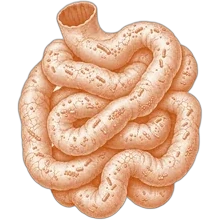
The other organ that filters.
Most patients arrive thinking the gut is about digestion. By the time they finish the first lab review, they understand it is about almost everything else.
The gut wall is a single layer of cells. On one side: the contents of the world — food, bacteria, viruses, toxins, drugs. On the other: the bloodstream and almost every organ. The wall’s job is to decide what gets through. When it does that job well, the rest of the body doesn’t have to fight for itself. When it doesn’t, the consequences show up far from the gut — in joints, skin, brain, kidneys, mood.
Dr. Irfan trained as a nephrologist, where the gut–kidney axis is one of the most under-appreciated relationships in medicine. Dysbiosis produces uremic toxins that the kidney must clear and that simultaneously damage it. That observation generalizes. The gut talks to the immune system the same way, the brain the same way, the metabolic system the same way. We treat the gut as the foundation it actually is.
What we treat.
Five conditions account for most of the work. They look distinct on the outside; on the inside, they share the same broken systems.
- 01IBS & SIBO — bloating, irregular bowels, post-meal discomfortMost common
- 02Leaky gut (intestinal permeability) — the upstream of most autoimmune diseaseFoundational
- 03Food sensitivities & intolerances — not allergy, but the long-tail of inflammationUnderdiagnosed
- 04Post-antibiotic recovery — restoring microbial diversity after a course (or twenty)Common
- 05Dysbiosis & chronic inflammation — the catch-all for everything elseVariable
Symptoms that send people here
The labels above are how doctors talk. These are how bodies talk — the symptoms that, taken together, almost always point to the same place.
The gut talks to everything.
Three axes carry the conversation. Get them right and most other systems follow. Get them wrong and no amount of downstream treatment holds.
Gut — immune
Seventy percent of immune cells live in the gut wall. The microbiome trains them — teaches them what is self, what is food, what is threat. A breached barrier or impoverished microbiome means an immune system that has lost its calibration. This is why almost every autoimmune protocol begins here.
Gut — brain
The vagus nerve runs both directions. The gut produces an estimated 90% of the body’s serotonin and a meaningful share of its dopamine. Anxiety, brain fog, low mood, and poor sleep are often gut-driven — and resolve when the gut does, even when nothing about the brain has been treated directly.
Gut — kidney
Dr. Irfan’s starting point. Dysbiosis produces uremic toxins — TMAO, indoxyl sulfate, p-cresyl sulfate — that the kidney has to clear and that damage it in the process. Patients with CKD who address the gut almost always see lab markers move that drugs do not touch.
- Stool testing
- Comprehensive, shotgun sequencing
- Permeability
- Zonulin, LPS, secretory IgA
- Food sensitivity
- IgG panel, elimination protocols
- Microbial markers
- Uremic toxins, SCFAs, mycotoxins
- Interventions
- Targeted probiotics, prebiotics, polyphenols, peptides
- Re-evaluation
- At 90 days
How an engagement works.
The protocol runs in four stages over twelve weeks. We re-evaluate at the end and decide whether to extend, taper, or hand back to maintenance.
- 01Discovery consultation — history, symptoms, prior workups, goalsby enquiry
- 02Functional testing — stool, permeability, food sensitivity, mycotoxinsBeyond standard
- 03Remove, replace, repair, restore — the four-stage protocol12 weeks
- 04Re-test & consolidate — objective markers + symptom trackingDay 90
Frequently asked.
Will I have to follow a strict diet?
For a window, yes. Elimination diets are diagnostic, not lifelong. Once we know what your body is reacting to, the diet opens back up — usually wider than where it started, because we’ve fixed the reasons it had to narrow.
Do you do food allergy testing?
We test for food sensitivities (IgG-mediated), which is different from acute allergy (IgE). Sensitivities are slower, lower-grade, and drive much of the chronic inflammation we see — but they are missed by allergy panels.
How is this different from a GI doctor?
A gastroenterologist diagnoses and treats structural disease — ulcers, IBD, cancer. We work on the functional layer — microbiome composition, barrier integrity, food reactivity, downstream inflammation. The two are complementary; if you need a gastroenterologist we coordinate.
What if my stool tests are normal?
Then we look at the next layer — permeability, food sensitivity, mycotoxins, SIBO breath testing. “Normal” on a screening test rarely means “nothing to find”; it usually means we have to look in the right place.
Ready for the conversation?
In-person in Houston, TX, or by video.